We use cookies to ensure you get the best user experience. For more information see our cookie policy.
Intro to Detection Engineering
Introduce the concept of detection engineering and the frameworks used towards crafting effective threat detection strategies.
Task 1: Introduction
Detection engineering is an important role and task for a security
analyst. It involves developing processes that will guide you as an
analyst to identify threats, detect them through rules and processes, and
fine-tune the process as the landscape changes.
Learning Objectives
Understand what Detection Engineering is.
Understand the Detection Engineering Lifecycle.
Identify various frameworks used in Detection Engineering.
Answer the questions below
Let's begin.
Task 2: What is Detection Engineering?
Detection Engineering
Cybersecurity is growing and evolving at a rapid rate, compounded by
the progress made in technology. With this, adversary actions are also
evolving, and cyber attacks are becoming so rampant and sophisticated
that it is difficult to keep up with them. Additionally, security teams must
develop and adapt to new mindsets and practices that will aid them in keeping up with adversaries. That’s where detection engineering comes in.
Detection engineering is the continuous process of building and operating threat intelligence analytics to identify potentially malicious activity or misconfigurations that may
affect your environment. It requires a cultural shift with the alignment
of all security teams and management to build effective threat-rich
defence systems.
Detection Types
Threat detection can be viewed from two perspectives, each comprising
two categories: The first
one, Environment-based detection, focuses on looking at
changes in an environment based on configurations and baseline
activities that have been defined. Within this detection, we have
Configuration detection and Modelling.
In the second perspective,
Threat-based detection focuses on elements associated
with an adversary’s activity, such as tactics, tools and artefacts
that would identify their actions. Under this, we have Indicators and
Threat Behaviour detections.
Configuration Detection
Under this detection, we use current knowledge of the known environment and infrastructure to identify misalignments.
Configurations can cross domains, including network, asset or
identity.
Configuration detection has the following benefits and
challenges:
Benefits
Challenges
The easiest form of detection to create and maintain in static
environments.
Difficult to maintain in dynamic environments.
Under perfect conditions and coverage, it detects all malicious
activity.
Limited visibility reduces effectiveness.
Individuals with different expertise can execute the detection.
There’s an assumption of knowledge of the working infrastructure and
configurations for effectiveness.
Easy to combine with other detections for forensics and
response.
Frequent configuration changes can result in high false
positives.
Modelling
Threat detection under this type is done by
defining baseline operations and activities and recording any deviations
that occur. The primary assumption of this approach is that malicious
activity can be sufficiently identified from benign activity.
The approach involves building an asset or activity profile that
includes baseline events, time and data threshold. An in-depth look into
baselining shall be discussed in the next task.
Some of the benefits and challenges of this detection method
include the following:
Benefits
Challenges
Used to identify unknown adversary activities due to model changes and not threat characteristics.
Provides no context of threat activity during investigations.
Easy to maintain in very static environments.
Difficult to maintain in dynamic environments.
Limited visibility reduces effectiveness.
Assumes in-depth knowledge of the working infrastructure and configurations.
Potentially adds existing malicious activity into the model.
Indicator Detection
As a reminder, indicators are pieces of information that identify a
state and context of an element or entity. There are both
good indicators used to identify legitimate activities or
resources, such as those used in whitelists, and bad
indicators used for suspicious or malicious resources, such as in
blacklists or malware IPs.
IOCs are commonly referenced and derived from
investigations against malicious events. By observing threat activities and investigations, analysts can use identified
indicators to craft detections and adapt them based on an adversary’s
rate of change.
Some of the benefits and challenges of this detection method
include the following:
Benefits
Challenges
Fastest detection to create and deploy.
The value of detection depends on the adversary’s rate of change.
Indicators raise specific threat contexts.
Retroactive in nature, one needs to observe the indicator first.
Useful for enriching data sources and detections.
Limited to some indicators that can be processed at a time.
Practical for scoping environments post investigation of indicators.
Unknown indicator expiry or change timelines can lead to false detections.
Threat Behaviour Detection
Analysts will look at an adversary’s Tactics, Techniques and Procedures (TTPs) to conduct an
attack, regardless of any specific indicators. This makes detection more
scalable beyond indicators.
Through this detection, analysts can focus their efforts more
efficiently on responding to the threat and mitigate against it instead of utilising time and resources to understand how and why alerts were triggered. Additionally, threat behaviour detection can be paired with established workflows and playbooks to provide best practices that can be followed during an investigation.
Some of the benefits and challenges of this detection method include the following:
Benefits
Challenges
Withstands the adversary’s rate of change.
Due to the adversary’s complexities, lots of data is required to provide complete coverage.
Easy to tune and adapt to different environments.
Moderately difficult to make initial implementations due to baseline assessments.
Low rates of false positives.
Only detects similar threat behaviour based on the set analytic.
Integrates with defensive playbooks and automated remediation plans.
Modifications must be made if detections must be reused across industries.
Combining these forms of detection results in more robust defence
systems. For example, model-based detection can be strengthened with
expert-led configuration detection to reduce the chances of having false
positives throwing alerts.
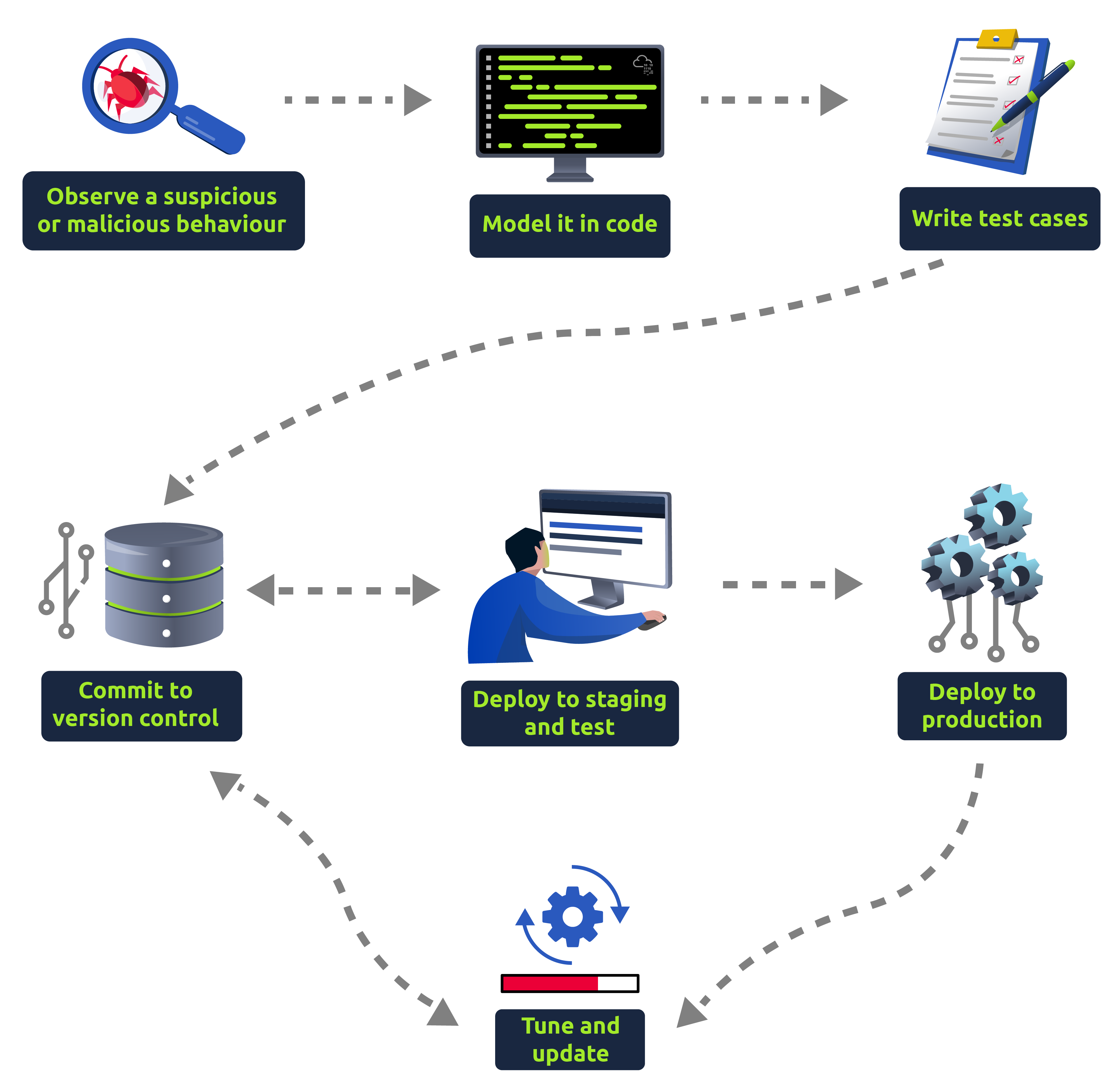
Detection as Code
Detection as Code (DaC) is a structured approach to writing
detections by incorporating software engineering best practice
principles. This means that detection engineers and analysts will handle
detection processes and logic as code, offering scalability to address
the rapidly changing environments and adversary capabilities.
DaC offers a code-driven workflow that creates fine-tuned detection
processes that introduce critical elements found in Continuous Integration/Continuous Development (CI/CD) workflows. Some of
these elements include:
Version Control: Most SIEMs and EDR products lack
the ability to track changes made to alerts and their definitions. By
introducing version control, detection rules and processes can be quickly
reviewed, tested and accounted for, enabling higher-quality
detections.
Automation workflows: By adopting a CI/CD workflow,
detection testing can be automated and allow quick transition and production delivery.
With that, Detection as Code provides the following benefits:
Customisable and Flexible Detections: Using a common language for detections, such as Sigma and YARA, offers an opportunity for DaC to be vendor-agnostic and be deployed across numerous SIEM, EDR, and XDR solutions.
Test-Driven Development: Quality testing of detection code can ensure that blind spots and false positive tests are identified earlier in the process and promote detection efficacy. Additionally, this approach improves the quality of detections and ensures they are well documented.
Team collaborations: Using the CI/CD workflows eliminates isolation between security teams and fosters collaboration through the coding process.
Code Reusability: With detection patterns emerging over time, engineers can reuse code to perform similar functions across different detections, ensuring that the detection process moves on faster since there won’t be the need to start from the beginning.
Answer the questions below
Which detection type focuses on misalignments within the current infrastructure?
Which detection approach involves building an asset or activity baseline profile for detection?
Which type of detection integrates with defensive playbooks?
Task 3: Detection Engineering Methodologies
Detection Gap Analysis
The first step involves looking at the environment and identifying
key areas where organisations can improve threat detection. This process is also
known as threat modelling and can be done in the
following ways:
Reactive: Assessing the most recent internal incident reports, taking note of the lessons learnt from the attacks and curving out missed areas of possible detection.
Proactive: Using the ATT&CK framework and
various threat intelligence sources to map out potential areas of attack
and the various TTPs that an adversary against your environment may use.
Note: Threat modelling in this context differs from the detection type discussed in the previous task.
Datasource
Identification and Log Collection
With information about the relevant threat actors, TTPs and potential
risks the organisation may face, sources of relevant data
associated with the risks need to be identified. This will determine
what logs are currently available that will aid in defining detections
against the threats and know which ones are missing and which are necessary.
Baseline Creation
Before using all the collected information about adversaries, their
TTPs and any malicious behaviour, security analysts need to know what
normal behaviour is and set their security baselines. This will be a
rolling process and requires participation from all departments within
an organisation.
Setting up security baselines involves identifying the different
types of devices running within an organisation based on their
operating system, services and functions. Security baselines can be
grouped into two categories:
High-level: This sets broad OS independent
standards guided by a specified security policy.
Technical: This consists of OS-based configuration
standards outlining different system functions and the intended
behaviours or activities. For example, technical baselines outline OS
hardening policies, network activities, Identity and Access Management (IAM) policies, and application
policies.
Log Collection
Once the baselines and sources of internal data have been identified
and prioritised, the collection of logs and metadata useful for threat
detection should be done. Depending on the infrastructure setup, a
centralised system may aggregate all logs using
network sensors for network data and services such as Sysmon to collect
host data.
Rule Writing
Based on the infrastructure setup and SIEM services, detection
rules will need to be written and tested against the data sources.
Detection rules test for abnormal patterns against logged events.
Network traffic would be assessed via Snort rules, while Yara rules would evaluate file data. Check out the Snort and Yara rooms for
more.
As part of the Detection Engineering module, we shall look at Sigma, a generic signature language used to write detection rules
against log files.
Deployment, Automation &
Tuning
Tested detection rules must be put into production to be assessed in a live environment. Over time, the detections would need to be modified and updated to account for changes in attack vectors, patterns or environment. This improves the quality of detections and encourages viewing detection as an ongoing process.
Answer the questions below
Read the above.
Task 4: Detection Engineering Frameworks 1
MITRE’s ATT&CK and CAR Frameworks
MITRE is well-known for publishing identified CVEs that adversaries
would look to exploit for their malicious activities. Additionally, MITRE provides knowledge-based access that security analysts
can use to track tactics and techniques commonly used by malicious
actors across different platforms such as Windows, macOS, Linux, and
Mobile.
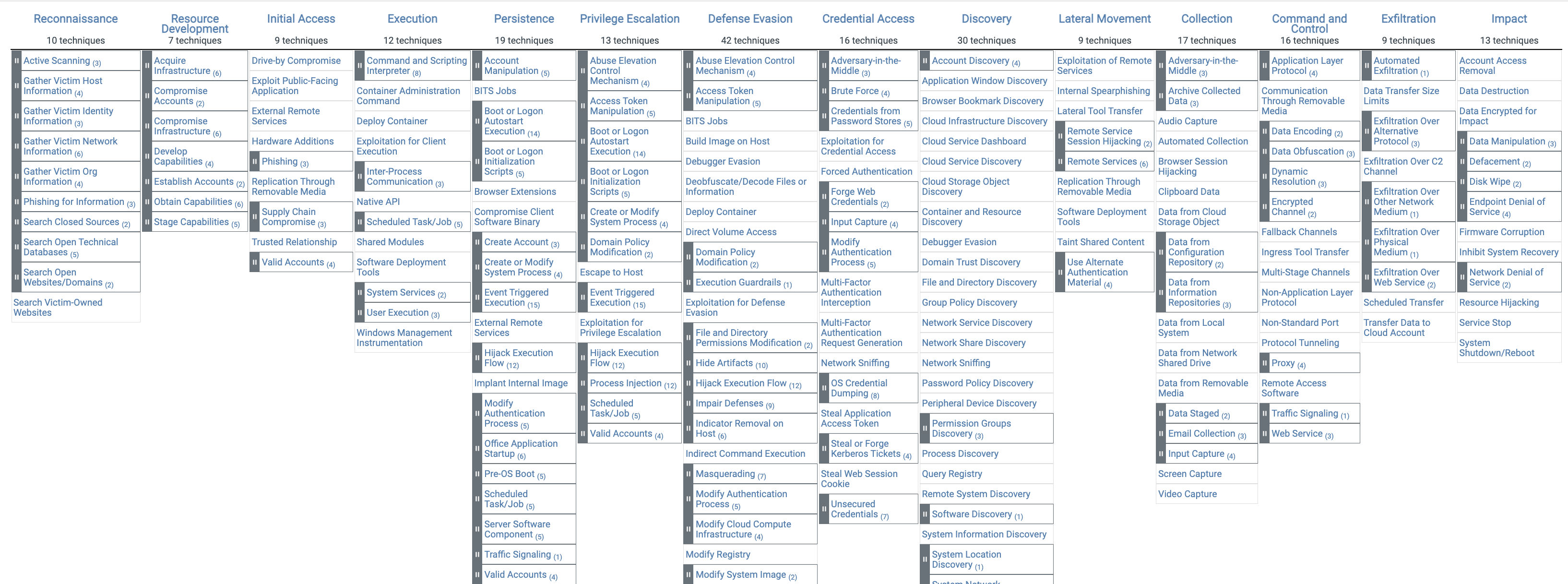
The ATT&CK framework helps map out adversarial actions based on the infrastructure in use for detection engineering. It guides what to look for, especially as part of the
detection gap analysis phase.
The CAR (Cyber Analytics
Repository) knowledge base is used to detect adversary behaviours
and prioritise them based on the ATT&CK framework.
Click to enlarge the image.
Pyramid of Pain
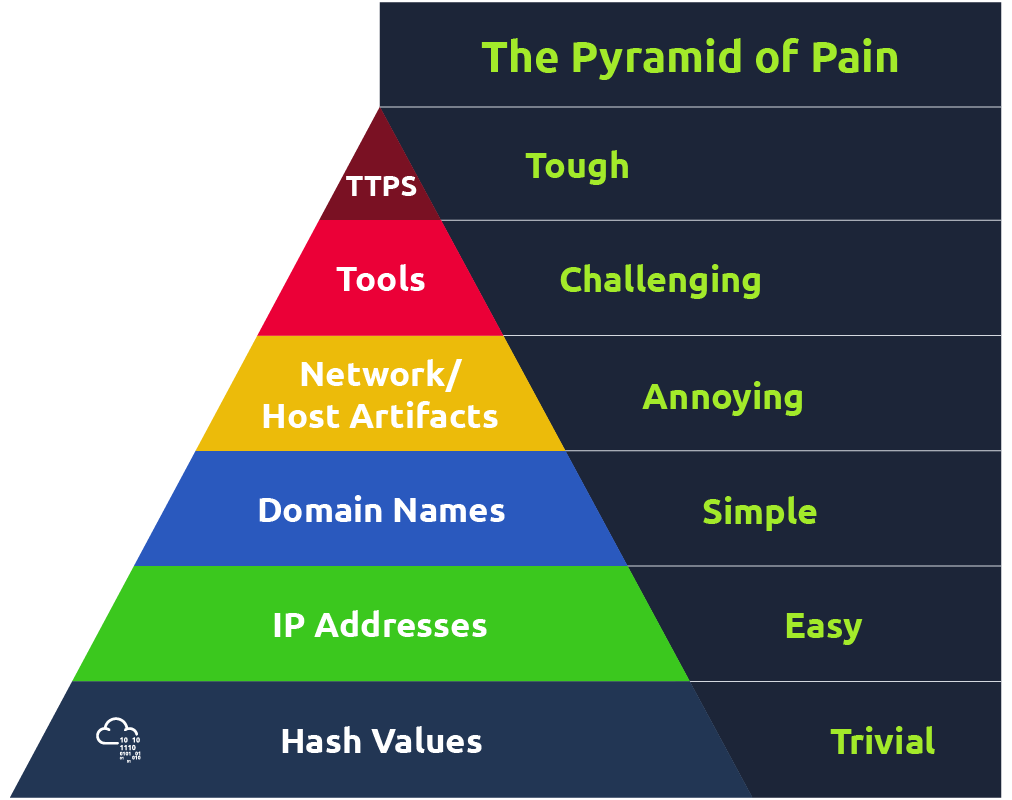
This is a well-known framework in the industry and is mainly used to showcase the pain for the adversary; if the defenders detect their TTPs, then how difficult and/or costly it would be for the adversary to change their TTPs.
Cyber Kill Chain
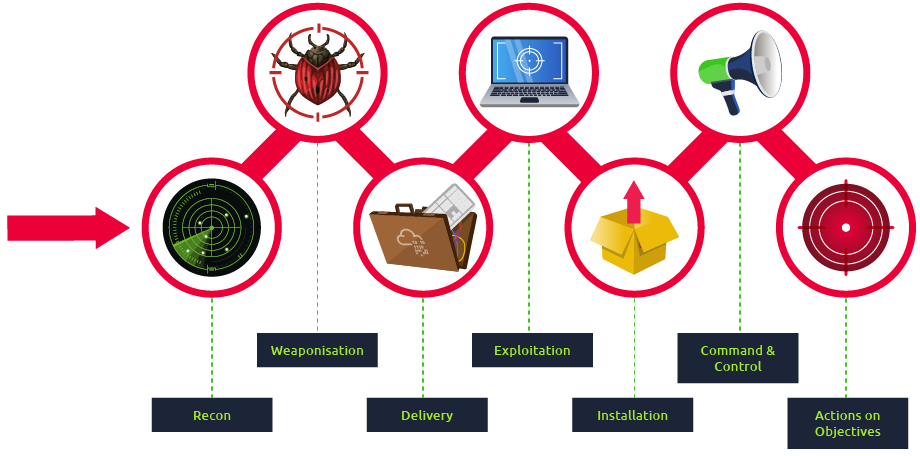
Thanks to a military concept of an attack strategy, Lockheed Martin
formulated the Cyber Kill Chain framework to define the necessary steps
followed by adversaries. The framework focuses on seven crucial phases
that cyber-attacks commonly follow:
Reconnaissance
Weaponisation
Delivery
Exploitation
Installation
Command & Control
Actions on Objectives
As a security analyst and detection engineer, understanding the Cyber
Kill Chain will give you the knowledge to recognise intrusion
attempts crafted by an adversary and map them into your detection
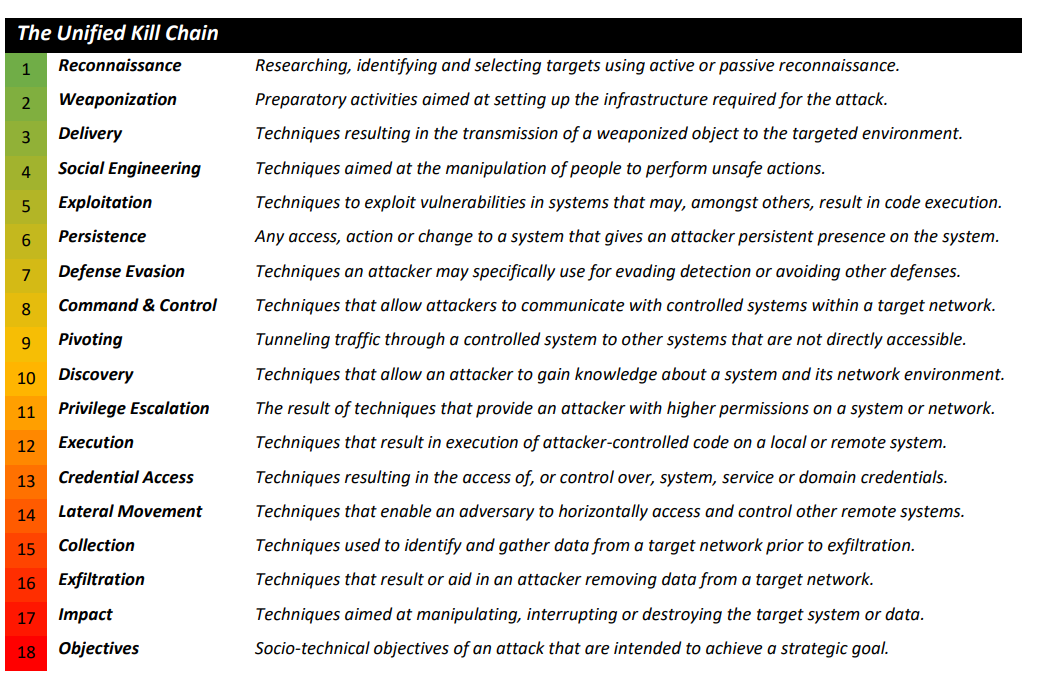
plan. The Unified Kill Chain was developed to complement the Cyber Kill
Chain by combining it with other frameworks, such as the MITRE ATT&CK
framework. This expanded the original kill chain into 18 phases to
cover every known element of a cyber attack.
If you are unfamiliar with these frameworks, check out these rooms
that will provide an in-depth understanding:
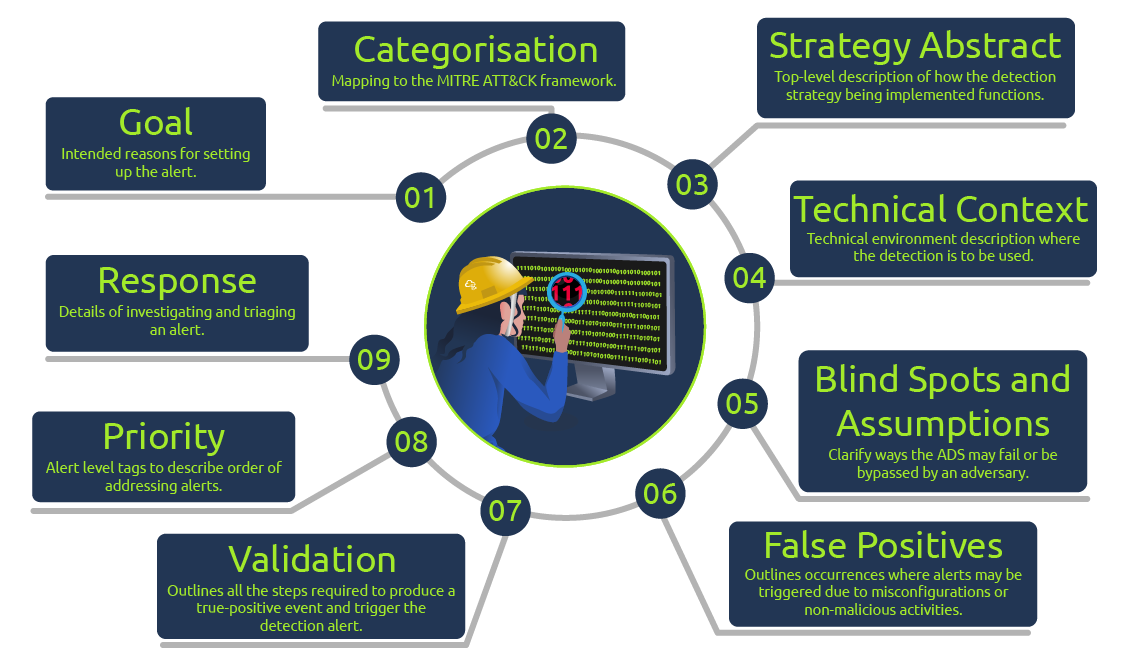
Palantir developed the ADS Framework to provide a guideline
for documenting detection content. A significant challenge faced
by security teams, and Palantir being no exception, is alert fatigue and
apathy, mainly caused by poor means of developing and implementing
detection alerts that would result in effective incident response and
mitigation. The ADS Framework seeks to address this challenge and
provide a guideline for constructing effective detections and
alerts.
The ADS Framework has a strict flow that detection engineers must follow before
publishing detection rules into production. The stages involved are:
Goal: Describes the intended reasons for setting
up the alert and the type of behaviour that needs to be
detected.
Categorisation: Mapping the detection to the
MITRE ATT&CK framework to provide analysts with information on the
TTPs for investigation and areas of the kill chain where the ADS will be used.
Strategy Abstract: Provides a top-level
description of how the detection strategy being implemented functions by
outlining what the alert will look for, the data sources,
enrichment resources and ways of reducing false positives.
Technical Context: Describes the technical
environment of the detection to be used, providing analysts and
responders with all the information needed to understand the alert. Security analysts should align this information with the platforms and tools for
collecting and processing threat alerts.
Blind Spots and Assumptions: Describes any
issues identified where suspicious activities may not trigger the strategy. Assumptions
and blind spots help clarify ways the ADS may fail or be bypassed by an
adversary.
False Positives: Outlines occurrences where
alerts may be triggered due to misconfigurations or non-malicious
activities within the environment. This makes it easy to
configure your SIEM to limit alert generation to only targetted threats
when pushed to production.
Validation: Every detection needs to be verified, and here, you can outline all the steps required to produce a true-positive event that would trigger the detection alert. Consider this
a unit test, which can even be a script or scenario used to
generate an alert. For an effective validation:
Develop a plan that will produce a true-positive outcome.
Document the process of the plan.
From the testing environment, test and trigger an alert.
Validate the strategy that triggered the alert.
Priority: Set up the alerting levels with which the
detection strategy may be tagged. This section provides the details
of the criteria used to set up the preferences, and it is separate from
the alerting levels shown through the SIEM.
Response: Provides details of how to triage and
investigate a detection alert. This information is helpful for analysts
and responders to be able to prevent extreme repercussions.
Detection Maturity Level Model
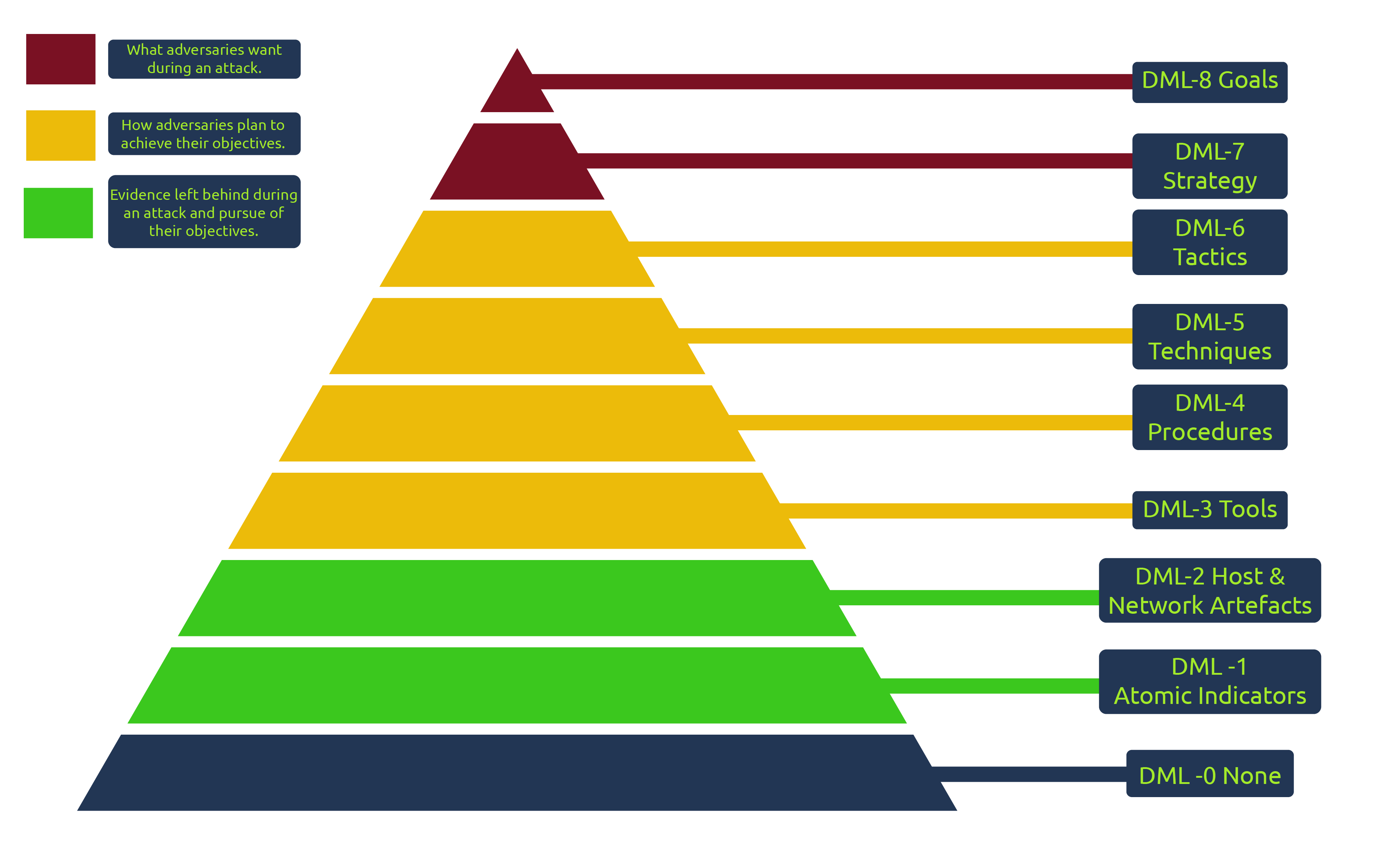
Ryan Stillions brought forward the Detection Maturity Level (DML) model in 2014 as a way for an organisation to assess its maturity levels concerning its ability to ingest and utilise
cyber threat intelligence in detecting adversary actions. According to
Ryan, there are two guiding principles for this model:
An organisation's maturity is not measured by its capabilities
of obtaining valuable intelligence but by its ability to apply it to detection and response.
Without established detection functions, there is no opportunity to
carry out response functions.
The DML model comprises nine dedicated maturity levels, numbered
from 0 to 8, with the lowest value representing technical aspects of an
attack and the highest level representing abstract and
intelligence-based aspects of an attack. The individual levels can be
described as follows:
DML-8 Goals: The pinnacle of the model represents
organisations that can detect an adversary's motive and goals.
Unfortunately, it is near impossible to conduct detections solely based
on goals, as in most cases, it is a guessing game based on behavioural
findings from lower DMLs.
DML-7 Strategy: Following closely after DML-8, this
level is non-technical and represents the adversary's intentions and
strategies to fulfil them. Organisations at this level would have a
mature intelligence source that will ensure they have context about
an adversary's plans, which will be helpful to responders.
DML-6 Tactics: Organisations must be able to detect
a tactic being used by an adversary without necessarily knowing which
technique or tool they used. Tactics are detectable after observing
patterns of events that aggregate over time and conditions.
DML-5 Techniques: Techniques usually are specific
to an individual or APT. Therefore, adversaries leave behind evidence of
their attack habits and behaviours and organisations that can
detect when a particular threat actor is within their environment are at
an advantage.
DML-4 Procedures: Organisations require to detect
sequences of events from an adversary at this level. They will be very
organised and follow a given pattern, such as the pre-exfiltration
reconnaissance.
DML-3 Tools: Detection of tools can fall into two
phases: the transfer phase where the tool is downloaded via the network onto a host device and resides on a file system or in memory. And the second is detecting through the tool's functionality and operation. In some cases, this detection
level would require organisations to perform reverse engineering against
adversarial tools, making it difficult to cause havoc
by understanding their tools' capabilities.
DML-2 Host & Network Artefacts: Most
organisational resources would be spent gathering IOCs and artefacts as threat intel at this level. Unfortunately, in most cases, indicators are
observed after the fact. The threat actor would likely be causing havoc
within the network when artefacts are picked up and investigated.
This has been described as "chasing the vapour trail of an
aircraft".
DML-1 Atomic Indicators: This level comprises organisations utilising threat intel feeds in the form of lists of
IP addresses and domains to detect threats.
DML-0 None: At the bottom of the model,
organisations that operate at this level have no detection processes
established.
In the original publication of the DML model, Ryan described four critical
use cases for the model, namely:
To provide a lexicon for more accessible communication of threat
information.
To assess detection maturity against monitored threat actors.
To assess the maturity of security vendors and products in use.
To provide context to analysts by including the DML levels in Yara
rules, Snort signatures and SIEM correlation rules.
Answer the questions below
Read the above.
Task 6: Detection Detective
Scenario: THM is seeking to establish a detection engineering process to detect changes made to privileged and administrative groups and accounts in their Active Directory. As a detection analyst, you have been tasked with developing the strategy based on a set of questions. Each question comes with one correct answer; therefore, it is
up to you to identify and select it. You will have three attempts to complete the exercise before it resets.
Use the Unusual Powershell Host Process ADS Framework template below as a guide to what each stage of the framework requires.
ADS Stage
Description
Goal
Detect when PowerShell is loaded into an unusual host process.
Powershell, built on the .NET framework, is a command-line shell and
scripting language for performing system management and automation. It
is a DLL entitled system.management.automation.dll but
also may exist as a native image or through the process
powershell.exe.
Attackers leverage Powershell as it
provides a high-level interface to interact with the OS without
requiring the development of functionality in C, C# or .NET. Sophisticated
adversaries may opt for the OPSEC-friendly method of injecting
Powershell into non-native hosts, commonly identified as unmanaged PowerShell.
Blind Spots & Assumptions
Endpoint tools are running correctly.
Endpoint logs are reported and forwarded to the SIEM.
SIEM is indexing endpoint logs successfully.
False Positives
A legitimate Powershell host is used and not suppressed via a
whitelist.
Introduce the concept of detection engineering and the frameworks used towards crafting effective threat detection strategies.
easy
60 min
36,842
To access material, start machines and answer questions login.
Detection engineering is an important role and task for a security
analyst. It involves developing processes that will guide you as an
analyst to identify threats, detect them through rules and processes, and
fine-tune the process as the landscape changes.
Learning Objectives
Understand what Detection Engineering is.
Understand the Detection Engineering Lifecycle.
Identify various frameworks used in Detection Engineering.
Answer the questions below
Let's begin.
Detection Engineering
Cybersecurity is growing and evolving at a rapid rate, compounded by
the progress made in technology. With this, adversary actions are also
evolving, and cyber attacks are becoming so rampant and sophisticated
that it is difficult to keep up with them. Additionally, security teams must
develop and adapt to new mindsets and practices that will aid them in keeping up with adversaries. That’s where detection engineering comes in.
Detection engineering is the continuous process of building and operating threat intelligence analytics to identify potentially malicious activity or misconfigurations that may
affect your environment. It requires a cultural shift with the alignment
of all security teams and management to build effective threat-rich
defence systems.
Detection Types
Threat detection can be viewed from two perspectives, each comprising
two categories: The first
one, Environment-based detection, focuses on looking at
changes in an environment based on configurations and baseline
activities that have been defined. Within this detection, we have
Configuration detection and Modelling.
In the second perspective,
Threat-based detection focuses on elements associated
with an adversary’s activity, such as tactics, tools and artefacts
that would identify their actions. Under this, we have Indicators and
Threat Behaviour detections.
Configuration Detection
Under this detection, we use current knowledge of the known environment and infrastructure to identify misalignments.
Configurations can cross domains, including network, asset or
identity.
Configuration detection has the following benefits and
challenges:
Benefits
Challenges
The easiest form of detection to create and maintain in static
environments.
Difficult to maintain in dynamic environments.
Under perfect conditions and coverage, it detects all malicious
activity.
Limited visibility reduces effectiveness.
Individuals with different expertise can execute the detection.
There’s an assumption of knowledge of the working infrastructure and
configurations for effectiveness.
Easy to combine with other detections for forensics and
response.
Frequent configuration changes can result in high false
positives.
Modelling
Threat detection under this type is done by
defining baseline operations and activities and recording any deviations
that occur. The primary assumption of this approach is that malicious
activity can be sufficiently identified from benign activity.
The approach involves building an asset or activity profile that
includes baseline events, time and data threshold. An in-depth look into
baselining shall be discussed in the next task.
Some of the benefits and challenges of this detection method
include the following:
Benefits
Challenges
Used to identify unknown adversary activities due to model changes and not threat characteristics.
Provides no context of threat activity during investigations.
Easy to maintain in very static environments.
Difficult to maintain in dynamic environments.
Limited visibility reduces effectiveness.
Assumes in-depth knowledge of the working infrastructure and configurations.
Potentially adds existing malicious activity into the model.
Indicator Detection
As a reminder, indicators are pieces of information that identify a
state and context of an element or entity. There are both
good indicators used to identify legitimate activities or
resources, such as those used in whitelists, and bad
indicators used for suspicious or malicious resources, such as in
blacklists or malware .
IOCs are commonly referenced and derived from
investigations against malicious events. By observing threat activities and investigations, analysts can use identified
indicators to craft detections and adapt them based on an adversary’s
rate of change.
Some of the benefits and challenges of this detection method
include the following:
Benefits
Challenges
Fastest detection to create and deploy.
The value of detection depends on the adversary’s rate of change.
Indicators raise specific threat contexts.
Retroactive in nature, one needs to observe the indicator first.
Useful for enriching data sources and detections.
Limited to some indicators that can be processed at a time.
Practical for scoping environments post investigation of indicators.
Unknown indicator expiry or change timelines can lead to false detections.
Threat Behaviour Detection
Analysts will look at an adversary’s Tactics, Techniques and Procedures (TTPs) to conduct an
attack, regardless of any specific indicators. This makes detection more
scalable beyond indicators.
Through this detection, analysts can focus their efforts more
efficiently on responding to the threat and mitigate against it instead of utilising time and resources to understand how and why alerts were triggered. Additionally, threat behaviour detection can be paired with established workflows and playbooks to provide best practices that can be followed during an investigation.
Some of the benefits and challenges of this detection method include the following:
Benefits
Challenges
Withstands the adversary’s rate of change.
Due to the adversary’s complexities, lots of data is required to provide complete coverage.
Easy to tune and adapt to different environments.
Moderately difficult to make initial implementations due to baseline assessments.
Low rates of false positives.
Only detects similar threat behaviour based on the set analytic.
Integrates with defensive playbooks and automated remediation plans.
Modifications must be made if detections must be reused across industries.
Combining these forms of detection results in more robust defence
systems. For example, model-based detection can be strengthened with
expert-led configuration detection to reduce the chances of having false
positives throwing alerts.
Detection as Code
Detection as Code (DaC) is a structured approach to writing
detections by incorporating software engineering best practice
principles. This means that detection engineers and analysts will handle
detection processes and logic as code, offering scalability to address
the rapidly changing environments and adversary capabilities.
DaC offers a code-driven workflow that creates fine-tuned detection
processes that introduce critical elements found in Continuous Integration/Continuous Development (/) workflows. Some of
these elements include:
Version Control: Most SIEMs and products lack
the ability to track changes made to alerts and their definitions. By
introducing version control, detection rules and processes can be quickly
reviewed, tested and accounted for, enabling higher-quality
detections.
Automation workflows: By adopting a workflow,
detection testing can be automated and allow quick transition and production delivery.
With that, Detection as Code provides the following benefits:
Customisable and Flexible Detections: Using a common language for detections, such as Sigma and YARA, offers an opportunity for DaC to be vendor-agnostic and be deployed across numerous , EDR, and XDR solutions.
Test-Driven Development: Quality testing of detection code can ensure that blind spots and false positive tests are identified earlier in the process and promote detection efficacy. Additionally, this approach improves the quality of detections and ensures they are well documented.
Team collaborations: Using the CI/CD workflows eliminates isolation between security teams and fosters collaboration through the coding process.
Code Reusability: With detection patterns emerging over time, engineers can reuse code to perform similar functions across different detections, ensuring that the detection process moves on faster since there won’t be the need to start from the beginning.
Answer the questions below
Which detection type focuses on misalignments within the current infrastructure?
Which detection approach involves building an asset or activity baseline profile for detection?
Which type of detection integrates with defensive playbooks?
Detection Gap Analysis
The first step involves looking at the environment and identifying
key areas where organisations can improve threat detection. This process is also
known as threat modelling and can be done in the
following ways:
Reactive: Assessing the most recent internal incident reports, taking note of the lessons learnt from the attacks and curving out missed areas of possible detection.
Proactive: Using the ATT&CK framework and
various threat intelligence sources to map out potential areas of attack
and the various TTPs that an adversary against your environment may use.
Note: Threat modelling in this context differs from the detection type discussed in the previous task.
Datasource
Identification and Log Collection
With information about the relevant threat actors, TTPs and potential
risks the organisation may face, sources of relevant data
associated with the risks need to be identified. This will determine
what logs are currently available that will aid in defining detections
against the threats and know which ones are missing and which are necessary.
Baseline Creation
Before using all the collected information about adversaries, their
TTPs and any malicious behaviour, security analysts need to know what
normal behaviour is and set their security baselines. This will be a
rolling process and requires participation from all departments within
an organisation.
Setting up security baselines involves identifying the different
types of devices running within an organisation based on their
operating system, services and functions. Security baselines can be
grouped into two categories:
High-level: This sets broad independent
standards guided by a specified security policy.
Technical: This consists of OS-based configuration
standards outlining different system functions and the intended
behaviours or activities. For example, technical baselines outline OS
hardening policies, network activities, Identity and Access Management () policies, and application
policies.
Log Collection
Once the baselines and sources of internal data have been identified
and prioritised, the collection of logs and metadata useful for threat
detection should be done. Depending on the infrastructure setup, a
centralised system may aggregate all logs using
network sensors for network data and services such as to collect
host data.
Rule Writing
Based on the infrastructure setup and services, detection
rules will need to be written and tested against the data sources.
Detection rules test for abnormal patterns against logged events.
Network traffic would be assessed via Snort rules, while Yara rules would evaluate file data. Check out the Snort and Yara rooms for
more.
As part of the Detection Engineering module, we shall look at Sigma, a generic signature language used to write detection rules
against log files.
Deployment, Automation &
Tuning
Tested detection rules must be put into production to be assessed in a live environment. Over time, the detections would need to be modified and updated to account for changes in attack vectors, patterns or environment. This improves the quality of detections and encourages viewing detection as an ongoing process.
Answer the questions below
Read the above.
’s ATT&CK and CAR Frameworks
MITRE is well-known for publishing identified CVEs that adversaries
would look to exploit for their malicious activities. Additionally, MITRE provides knowledge-based access that security analysts
can use to track tactics and techniques commonly used by malicious
actors across different platforms such as Windows, macOS, , and
Mobile.
The ATT&CK framework helps map out adversarial actions based on the infrastructure in use for detection engineering. It guides what to look for, especially as part of the
detection gap analysis phase.
The CAR (Cyber Analytics
Repository) knowledge base is used to detect adversary behaviours
and prioritise them based on the ATT&CK framework.
Click to enlarge the image.
Pyramid of Pain
This is a well-known framework in the industry and is mainly used to showcase the pain for the adversary; if the defenders detect their TTPs, then how difficult and/or costly it would be for the adversary to change their TTPs.
Cyber Kill Chain
Thanks to a military concept of an attack strategy, Lockheed Martin
formulated the Cyber Kill Chain framework to define the necessary steps
followed by adversaries. The framework focuses on seven crucial phases
that cyber-attacks commonly follow:
Reconnaissance
Weaponisation
Delivery
Exploitation
Installation
Command & Control
Actions on Objectives
As a security analyst and detection engineer, understanding the Cyber
Kill Chain will give you the knowledge to recognise intrusion
attempts crafted by an adversary and map them into your detection
plan. The Unified Kill Chain was developed to complement the Cyber Kill
Chain by combining it with other frameworks, such as the MITRE ATT&CK
framework. This expanded the original kill chain into 18 phases to
cover every known element of a cyber attack.
If you are unfamiliar with these frameworks, check out these rooms
that will provide an in-depth understanding:
Palantir developed the ADS Framework to provide a guideline
for documenting detection content. A significant challenge faced
by security teams, and Palantir being no exception, is alert fatigue and
apathy, mainly caused by poor means of developing and implementing
detection alerts that would result in effective incident response and
mitigation. The ADS Framework seeks to address this challenge and
provide a guideline for constructing effective detections and
alerts.
The ADS Framework has a strict flow that detection engineers must follow before
publishing detection rules into production. The stages involved are:
Goal: Describes the intended reasons for setting
up the alert and the type of behaviour that needs to be
detected.
Categorisation: Mapping the detection to the
ATT&CK framework to provide analysts with information on the
TTPs for investigation and areas of the kill chain where the ADS will be used.
Strategy Abstract: Provides a top-level
description of how the detection strategy being implemented functions by
outlining what the alert will look for, the data sources,
enrichment resources and ways of reducing false positives.
Technical Context: Describes the technical
environment of the detection to be used, providing analysts and
responders with all the information needed to understand the alert. Security analysts should align this information with the platforms and tools for
collecting and processing threat alerts.
Blind Spots and Assumptions: Describes any
issues identified where suspicious activities may not trigger the strategy. Assumptions
and blind spots help clarify ways the ADS may fail or be bypassed by an
adversary.
False Positives: Outlines occurrences where
alerts may be triggered due to misconfigurations or non-malicious
activities within the environment. This makes it easy to
configure your to limit alert generation to only targetted threats
when pushed to production.
Validation: Every detection needs to be verified, and here, you can outline all the steps required to produce a true-positive event that would trigger the detection alert. Consider this
a unit test, which can even be a script or scenario used to
generate an alert. For an effective validation:
Develop a plan that will produce a true-positive outcome.
Document the process of the plan.
From the testing environment, test and trigger an alert.
Validate the strategy that triggered the alert.
Priority: Set up the alerting levels with which the
detection strategy may be tagged. This section provides the details
of the criteria used to set up the preferences, and it is separate from
the alerting levels shown through the SIEM.
Response: Provides details of how to triage and
investigate a detection alert. This information is helpful for analysts
and responders to be able to prevent extreme repercussions.
Detection Maturity Level Model
Ryan Stillions brought forward the Detection Maturity Level (DML) model in 2014 as a way for an organisation to assess its maturity levels concerning its ability to ingest and utilise
cyber threat intelligence in detecting adversary actions. According to
Ryan, there are two guiding principles for this model:
An organisation's maturity is not measured by its capabilities
of obtaining valuable intelligence but by its ability to apply it to detection and response.
Without established detection functions, there is no opportunity to
carry out response functions.
The DML model comprises nine dedicated maturity levels, numbered
from 0 to 8, with the lowest value representing technical aspects of an
attack and the highest level representing abstract and
intelligence-based aspects of an attack. The individual levels can be
described as follows:
DML-8 Goals: The pinnacle of the model represents
organisations that can detect an adversary's motive and goals.
Unfortunately, it is near impossible to conduct detections solely based
on goals, as in most cases, it is a guessing game based on behavioural
findings from lower DMLs.
DML-7 Strategy: Following closely after DML-8, this
level is non-technical and represents the adversary's intentions and
strategies to fulfil them. Organisations at this level would have a
mature intelligence source that will ensure they have context about
an adversary's plans, which will be helpful to responders.
DML-6 Tactics: Organisations must be able to detect
a tactic being used by an adversary without necessarily knowing which
technique or tool they used. Tactics are detectable after observing
patterns of events that aggregate over time and conditions.
DML-5 Techniques: Techniques usually are specific
to an individual or . Therefore, adversaries leave behind evidence of
their attack habits and behaviours and organisations that can
detect when a particular threat actor is within their environment are at
an advantage.
DML-4 Procedures: Organisations require to detect
sequences of events from an adversary at this level. They will be very
organised and follow a given pattern, such as the pre-exfiltration
reconnaissance.
DML-3 Tools: Detection of tools can fall into two
phases: the transfer phase where the tool is downloaded via the network onto a host device and resides on a file system or in memory. And the second is detecting through the tool's functionality and operation. In some cases, this detection
level would require organisations to perform reverse engineering against
adversarial tools, making it difficult to cause havoc
by understanding their tools' capabilities.
DML-2 Host & Network Artefacts: Most
organisational resources would be spent gathering IOCs and artefacts as threat intel at this level. Unfortunately, in most cases, indicators are
observed after the fact. The threat actor would likely be causing havoc
within the network when artefacts are picked up and investigated.
This has been described as "chasing the vapour trail of an
aircraft".
DML-1 Atomic Indicators: This level comprises organisations utilising threat intel feeds in the form of lists of
IP addresses and domains to detect threats.
DML-0 None: At the bottom of the model,
organisations that operate at this level have no detection processes
established.
In the original publication of the DML model, Ryan described four critical
use cases for the model, namely:
To provide a lexicon for more accessible communication of threat
information.
To assess detection maturity against monitored threat actors.
To assess the maturity of security vendors and products in use.
To provide context to analysts by including the DML levels in Yara
rules, Snort signatures and SIEM correlation rules.
Answer the questions below
Read the above.
Scenario: is seeking to establish a detection engineering process to detect changes made to privileged and administrative groups and accounts in their Active Directory. As a detection analyst, you have been tasked with developing the strategy based on a set of questions. Each question comes with one correct answer; therefore, it is
up to you to identify and select it. You will have three attempts to complete the exercise before it resets.
Use the Unusual Host Process ADS Framework template below as a guide to what each stage of the framework requires.
ADS Stage
Description
Goal
Detect when PowerShell is loaded into an unusual host process.
Powershell, built on the .NET framework, is a command-line shell and
scripting language for performing system management and automation. It
is a DLL entitled system.management.automation.dll but
also may exist as a native image or through the process
powershell.exe.
Attackers leverage Powershell as it
provides a high-level interface to interact with the without
requiring the development of functionality in C, C# or .NET. Sophisticated
adversaries may opt for the -friendly method of injecting
Powershell into non-native hosts, commonly identified as unmanaged PowerShell.
Blind Spots & Assumptions
Endpoint tools are running correctly.
Endpoint logs are reported and forwarded to the .
SIEM is endpoint logs successfully.
False Positives
A legitimate Powershell host is used and not suppressed via a
whitelist.