Task 1: Introduction
Introduction
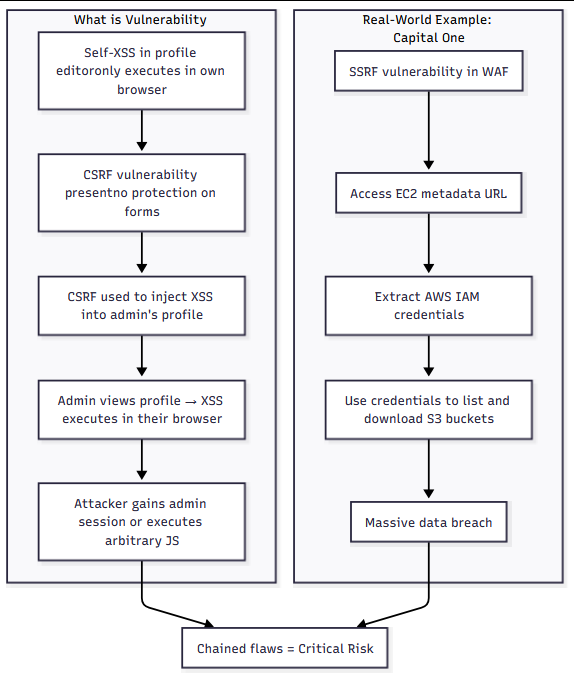
When we talk about vulnerability chaining, we're referring to the idea that a single bug on its own might not seem like a big deal, but when combined with others, it can become dangerous. This is how real-world attackers think: not every vulnerability needs to be critical, as long as it helps them move forward. In fact, attackers often rely on several "low-risk" or "medium-risk" issues to gradually work their way to a serious compromise.
This brings us to something important that's often overlooked when reading pentest reports: risk ratings are assigned per vulnerability in isolation. Organisations usually focus on remediating the criticals and highs, while deferring or accepting mediums and lows. But this mindset can be misleading. A medium-risk vulnerability like verbose error messages or weak password policy might not get immediate attention, but when chained together with other issues like missing CSRF protection or XSS, it could lead to a much higher-impact exploit. Sometimes, chaining multiple medium-rated issues results in a more damaging outcome than a single high-risk finding would have caused on its own.
This room will walk you through how attackers approach an application holistically, looking for anything they can use, combining findings, and building on their access step by step. You'll go beyond checking for individual bugs and start recognising how everything fits together from an attacker's point of view.
Objectives
By the end of this room, you'll be able to:
- Think like an attacker: Learn how to treat even small findings as potential stepping stones.
- Understand common chains: Some bugs naturally pair well together. You'll learn why.
- Recognise weak boundaries: Identify where trust breaks down between different parts of a web application.
- Follow a real chain: You'll go from first access to remote code execution by chaining multiple low-to-medium severity issues.
Pre-requisites
Before starting this room, you should already be familiar with the fundamentals of web application security, including vulnerabilities like:
- Cross-Site Scripting (XSS)
- Cross-Site Request Forgery (CSRF)
- Weak authentication and session management
If you haven't already, we strongly recommend completing the Web Application Pentesting learning pathway first, as this room builds directly on concepts introduced there.
Answer the questions below
Click me to proceed to the next task.